Eviction Hurts Kids
The Overlooked Impact on Education and Family Stability
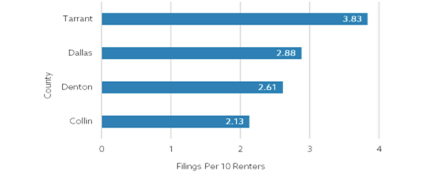
Eviction is more than a housing crisis—it’s a family crisis. In 2023, there were more than 35,000 eviction filings in Tarrant County, averaging nearly 3,000 per month. That’s approximately 4 evictions for every 10 renters—five times the national average. [1] The most affected households are disproportionately headed by single mothers, and families who are Black or Hispanic.
North Texas Evictions Per 10 Renters
“Due to the perfect storm of record high rent rates, lack of affordable child care and wages that have stagnated, low-income families headed by single mothers are simply priced out of the market. Even working multiple jobs, single mothers have a difficult time keeping a roof over their children’s heads,” said Carol Klocek, CEO of Center for Transforming Lives.
The consequences ripple far beyond losing a home:
Eviction is not just a temporary setback—it’s a disruption with lasting effects on children’s futures.
Following a unanimous vote by the Tarrant County Commissioners Court, Center for Transforming Lives was recently awarded $2.3 million of the Community Outreach Fund to provide critical rental and utility assistance to low-income households facing eviction, utility disconnection and homelessness. Read more about this key resource for families facing eviction: Tarrant County Community Outreach Fund
To delve deeper into the insights shared here, we invite you to read the full publication Disrupting Poverty and Promoting Well-Being for Single Mother Families in Tarrant County www.transforminglives.org/research.
[1] The Eviction Lab. (2018). National Estimates: Eviction in America. Princeton University. https://evictionlab.org/national-estimates/[2] Hepburn, P., Grubbs-Donovan, D., Graetz, N., Jin, O., & Desmond, M. (2025). Consequences of Eviction-Led Forced Mobility for School-Age Children in Houston. Sociology of Education.[3] Desmond, M., & Kimbro, R. T. (2015). Eviction’s Fallout: Housing, Hardship, and Health. Social Forces, 94(1), 295-324[4] Tsai, A. C. (2020). Home Eviction and Suicide in the United States. Journal of Urban Health, 97(3), 405-412.[5] Khadka, A., Fink, G., Gromis, A., & McConnell, M. (2020). In utero exposure to threat of evictions and preterm birth: evidence from the United States. Health services research, 55, 823–32.[6] Humphries, J. E., Mader, N., Tannenbaum, D., & van Dijk, W. (2019). Does Eviction Cause Poverty? Quasi-Experimental Evidence from Cook County, IL. National Bureau of Economic Research Working Paper No. 26139.[7] Collinson, R., & Reed, D. (2018). The Effects of Evictions on Low-Income Households. Stanford University Working Paper.
Categories: Research
Center for Transforming Lives partners with single mothers and their children so they can thrive. Our services are two-generational and establish long-term financial and emotional well-being.
3001 S. Riverside Drive
Fort Worth, Texas 76119
info@transforminglives.org
(817) 332-6191
.png?337x101)
-
Copyright 2024